
Archive
Paving and Paradise
By Joel M. Hoffman
Pave over a field and an amazing thing happens each spring: grass grows through the blacktop. Somehow, even the industrial strength of the pavement, powerful enough to support the tonnage of trucks, can’t stop a single, fragile, nascent blade of grass yearning for light.
At this time of year, we are like the grass.
Our springtime holiday of freedom ended a short while ago. Our next major celebration comes exactly fifty days after Passover, on May 29, this year. It’s Shavu’ot, the day that commemorates when we stood at Mt. Sinai and received the Torah. The 49-day period in between is called the Omer, and it’s a time of spiritual limbo. We have our freedom, but we don’t yet have guidance from Torah. So we can do what we want, but we don’t know what we should do. The Omer is our yearly moral navigation check-up, a time to ask: “Am I going in the right direction?”
The seven week period of the Omer (“seven weeks of seven days,” it’s called in the Torah) has become so important that we traditionally count each day. When we do, we note the total number of days, and also how many weeks they comprise. Mother’s Day, for example, falls this year on the 31st day of the Omer, which is four weeks and three days into the Omer. That’s how it’s done.
It’s a period of high emotion. For some people, most of the Omer is a season of mourning, during which weddings are forbidden and even pleasurable music is not allowed. But the 33rd day of the Omer — lag ba’omer, in Hebrew — is a day of rejoicing. So is Jerusalem Day, on the 43 day of the Omer. (If you want a traditional springtime wedding, it has to be on the 33rd day of the Omer, making that day one of the hardest times to find a wedding hall in Israel.)
We juxtapose confirmation with Shavu’ot, using our celebration of Torah to publicly acknowledge the students who have chosen to continue their Jewish education. Bar/bat mitzvah may have been when they became Jewish adults, allowed to make their own ritual decisions, but without Torah, how will they decide what to do? That’s one reason we hope they continue to study.
Shavu’ot usually comes around the last day of Religious School, as if to underscore the connection between going to Religious School and working to accept Torah. On Shavu’ot, we celebrate another successful year of school.
And Shavu’ot, like Memorial Day, marks the beginning of summer.
In Aramaic — the language of the Talmud and of prayers such as the Kadish — the word for Torah is oraita, literally, “the light.” In this context, we are all like the grass that breaks through the blacktop. The grass is searching for the sun. We are searching for our light, the light that is Torah. And our job during the Omer is to find it. Like for the grass, sometimes seemingly insurmountable obstacles block our path. Instead of blacktop, we have to overcome petty rivalry, jealousy, hatred, and ego, just to name a few. These are often harder than pavement.
There’s another way our journey is more difficult than that of the grass. Gravity causes chemicals called auxins to pool in the lower part of the grass shoot, which then has no choice but to grow upward. It will eventually find light. We have more freedom. We can go anywhere we want, do anything we please. We can grow toward Torah, or shift away from it. The Omer is our time to ask if we are going in the right direction: Are we becoming better people? Are we working toward the right goals? Are we proud of where we’re going and what we’re working to do?
We have one final thing in common with the grass. We can’t see the light until we overcome the obstacles blocking our path. The Omer can be dark and frustrating, but if we spend our time wisely, it will be worth it.
Do Not Oppress The Stranger
By Joel M. Hoffman
“Do not oppress the stranger,” the Bible warns us over and over again, “for you were strangers in the land of Egypt.” The saga of the Jewish people is to know what it’s like not to fit in, which is why this notion of welcoming the stranger defines Judaism as much as any other central precept.
The English word “stranger” offers us additional insight into what the Bible is talking about, because our word is nicely ambiguous. A “stranger” is someone from another place, but, equally, “stranger” is “more than just strange.” And of course that’s why being from another place is so hard. When you go somewhere new, you think everyone else is strange, and they all think you are. Visitors wonder at our customs just as we wonder at theirs.
So we learn not only that we shouldn’t oppress the stranger, but equally that we shouldn’t oppress people who are strange.
It’s important, for being from a foreign place is only one way of being strange. There are many others. In fact, Scott Dunn teaches that anyone who lives honestly in the world is perceived as a little bit strange. People wear odd clothes, walk crooked, have funny body shapes, listen to bizarre music, say strange things, have silly habits, and on and on. Are we careful not to oppress them?
I know a student with what she calls — having been told to call it so by her doctor — ADD. I understand the ‘A.’ It stands for “attention.” I even understand the first ‘D,’ which stands for “deficit.” She has an attention deficit, which is a not-so-polite way of saying she has trouble paying attention to one thing at a time. A nicer way to explain her situation would be that she can focus on more than one thing at a time, a skill that helps her notice connections that others often miss, and a quality that makes her a consistently interesting interlocutor.
As bad as the first ‘D’ is, though, it’s the second that really troubles me. It stands for “disorder.” What happened to “do not oppress”? When we classify people’s thinking — their natural way of being in the world — as a “disorder,” haven’t we pretty much destroyed any hope of welcoming them?
To be sure, some behaviors and conditions are more conducive to happiness and success than others. Just as I wear eye glasses so I can see better, attention deficit should be dealt with (if possible) when it stands in the way of a person’s goals. By the same reasoning, life-threatening obesity should be managed. And obsessive-compulsive behavior — normally called obsessive-compulsive disorder, once again making it hard to welcome those with the condition — can be a curious quirk or a debilitating disease, and in the latter case treatment seems like a good idea.
But whatever the nature of the oddity, Judaism expressly forbids negative name calling. We are all strange in our own way, and words like “disorder” have no place in our holy community. We can recognize our differences — and even note that some differences are advantageous or disadvantageous — without stacking people up in a hierarchy of normalcy.
This message is a cornerstone of our school. “No one fails Judaism,” Rabbi Manny Gold teaches, “but if we’re not careful, Judaism can fail them.” Part of my job as Director of Education is to make sure that our school welcomes whoever walks through our doors, even though some students will seem strange. After all, we’re all strange. Some of us just hide it better than others.
Purim arrives this month. It’s a holiday that freely mixes silly masquerading with serious messages. It’s also a time when we all practice being strange and, if we’re really doing things right, practice welcoming those who are strange.
“Do not oppress the stranger,” we are taught. This year, let’s use our Purim partying and seemingly frivolous merrymaking as a mental reminder not to oppress the stranger, the strangest, or even the merely strange.
The Facebook Generation
By Joel M. Hoffman
I recently asked a middle-school student how many friends she has.
“Eight hundred and sixty,” she told me.
“That’s funny,” I replied. “I have about a dozen.” And then I added, “I guess we’re using the word `friends’ differently.”
She was talking about Facebook friends, and, for lack of a better way of describing it, I was talking about “real” friends.
Facebook is a “social networking” site, which I guess means that it’s a way of being social on-line. According to Facebook itself, its 140 million members spend an average of almost 20 minutes each day “on Facebook.” Taking into account the members who don’t use the site daily, that works out to well over half an hour for most Facebook users. Each day.
Facebook’s basic relationship is “friend,” which, it turns out, is both a noun and a verb. A “friend” is what you become when someone invites you, and when you want someone to be your friend, what you do is “friend” them. Facebook conveniently keeps a list of the people you have friended.
Once you’ve become friends with someone on Facebook, you can interact electronically. You can send your friends messages, which is just like the e-mail that now seems like last century’s technology. In addition, your can share pictures with your friends. You upload a photo to Facebook, and then all of your friends — and only your friends — see that it’s there. You can also share one-line updates about your life. “I’m going to mall,” you can post, and then all of your friends will know your plans. If you’re having a bad day, you can tell people. They know about your life, and you know about theirs.
But that’s not all. You can also send them, for example, plants.
That’s right. You click on the right buttons and you send your friends a living, growing, plant. Except that it’s not alive. And it doesn’t grow. And it’s a not a plant.
So what’s going on? And why are 140 million people doing this? Why are so many people, and, in particular, so many young people, practically addicted to “social networking”? What is the point of pushing a button on your computer so a message on someone else’s mentions a gift in the form of a virtual plant? Couldn’t this time be spent on something more productive?
In much the same way that teenagers usually think that they alone are going through the awkward changes of puberty, and that no one understands them, each generation thinks that the older ones wrongly judged them, but that they are justified in judging the younger ones. Our parents misunderstood our generation, we all think, but we understand the failings of our children’s. They text message instead of talking. Their music is terrible. They don’t even send real plants. And don’t even get us started on how they dress.
But if we really want to learn for our experience, let us remember that sometimes the older generation (us!) really doesn’t appreciate the younger one. Styles change. Different doesn’t have to mean worse.
My grandfather was convinced that the only appropriate attire outside the house was a jacket and tie. If he had known that I show show up at Temple wearing neither, he would quite honestly have been ashamed. Never mind the fact that I don’t even own a hat. But he would have been wrong in his assessment. Not everyone wears a jacket and tie, or a hat, these days, and we all know that there’s nothing wrong with that.
We should offer the same consideration to children. Let us be careful when we judge their behavior by our standards. Let us be careful not to repeat our parents’ mistakes.
After all, sending a virtual plant is one really good way of taking seriously the old adage that, “it’s the thought that counts.” And for a generation usually labeled as materialistic, this on-line Facebook experience is a remarkable way to interact.
When we open our minds and suspend judgment, it’s amazing what our children can teach us.
The Saga of Family Life: Vayigash
By Joel M. Hoffman
Vayigash, this week’s Torah portion, opens with the nearly final stages of the drama of the misery and anguish of our ancestors’ family lives. But amid the sorrow we also find the promise of better times.
We read of Judah in Egypt as he begs for life-saving food from a man who will turn out to be his brother Joseph. Joseph, now the second most powerful man in Egypt, looks back at the man he knows to be his long-estranged brother Judah.
Both Judah and Joseph were victims of their father Jacob’s atrocious parenting skills, as evidenced, for example, by Jacob’s decision to give Joseph a fancy coat but to give nothing to any of Joseph’s brothers. (“Here’s a Hanukah experiment you can try at home,” Rabbi Larry Kushner teaches in this regard. “See what happens if you give an expensive present to only one of your children….”) So back in Canaan, Judah had helped sell Joseph to their cousins, the Ishmaelites, as a slave. Jacob was distraught at the loss of his son, Judah seemed not to care, and for a while slavery was too good for Joseph. He spent time in an Egyptian jail.
It is perhaps not Jacob’s fault that he never learned to be a good parent. His mother and father fought over which child they loved more, and Esau was always Daddy’s favorite. Jacob’s mother was conniving and devious. Jacob’s father quickly grew so senile that he couldn’t tell the difference between his son and a sheep.
Isaac, of course, learned from his own father, Abraham, the father who took him on a father-and-son outing where he almost sacrificed him on Mount Moriah.
In addition, Jacob inadvertently married the wrong woman. We can only imagine the sibling rivalry that results when your sister is also your husband’s favorite wife.
Jealousy, pettiness, and sibling rivalry seem to be the only family dynamics Jacob knew. So perhaps we understand why Jacob was unable to keep his family together. If Genesis is about families, it is about dysfunctional families, as Abraham, Isaac, and Jacob make abundantly clear, along with Ishmael, Hagar, Esau, and so forth. Not one of them lived a particularly happy life.
Still, never one to learn from his mistakes, Jacob gathers all of his remaining children together when the family is faced with famine:
“I want all of you to go down to Egypt to try to get us some food,” he instructs his children. But then he clarifies what he wants: “All of you except Benjamin, that is.”
Why not Benjamin?
“Because I love him,” Jacob tells his children.
The message is clear.
Eventually, Benjamin must join his brothers in Egypt, and that brings us to this week’s installment of “what else can go wrong.” Joseph, now viceroy of Egypt, demands that Benjamin stay behind and not return to their father.
But that’s not an option, Judah knows. “If my father sees that Benjamin is gone, he will die,” Judah tells the powerful Egyptian leader.
Judah has understood the situation fully. Daddy will die if Benjamin doesn’t return. But Daddy doesn’t care about him. “Let me stay in his place,” Judah offers. “Daddy won’t even miss me,” he knows.
In offering to stay behind instead of Benjamin, Judah recognizes his father’s failings, and, more importantly, he accepts them. This is the moment he breaks the cycle of family dysfunction that plagued the first four generations of our ancestors’ lives.
Genesis, of course, is about us. For we are Abraham, sometimes angry at our children, and we are Rachel and Leah, jealous of our siblings. We are Judah, still trying to understand why our parents cannot be perfect. We are all of them.
Let us not forget that things turned out very well for Judah, a fact we mark at every wedding when we quote the prophet Jeremiah: “Once again there will be heard among Judah the sounds of joy and happiness, the sounds of the bride and groom.”
Let us pray that God give us the courage to learn from Judah and accept reality. And let us look forward to the joy and happiness that await when we do.
Shabbat Shalom.
There’s a Famine in the Land
By Joel M. Hoffman
Genesis is about families, creation, where we come from, and what our lives are like. But it is also about famine. In fact, famine was so common that Genesis 26:1 begins, “there was a famine in the land,” but then the text has to clarify that it wasn’t the first famine, it was another famine.
Abraham and Sarah endured a famine. So did Isaac and Rebekkah. And so did Jacob, Rachel, and Leah, along with their children. Joseph was spared hunger, but that doesn’t mean that the famine didn’t impact his life. In fact, it was the famine that led to his rise in the ranks of the Egyptian power structure. Whether for the better or for the worse, famine shaped our people’s early life.
Three things about famines are important.
First, they always happen “in the land.” Even though some people suffer more than others, and even though some people, like Joseph, actually benefit, no famine is a personal famine. Famines belong collectively to everyone in “the land.”
Secondly, famines are not sent by God. They just happen. Our text does not read, “God sent a famine,” or, “God punished Abraham with a famine,” or even, “God tested Abraham with a famine,” but rather the clearer and more accurate, “a famine happened.”
Thirdly, when our ancestors suffered during a famine, they didn’t try to hide their pain. Their only reaction was to acknowledge their undeserved misfortune and try to make things better. They looked for food. Genesis 12:10 reads: “There was a famine in the land, so Abram went down to Egypt” to get food. He didn’t sneak out of the house (well, tent) trying to hide his situation. He accepted the problem and set out to try to solve it.
All of this seems suddenly relevant in 2009 America as our own savings accounts dwindle and as some of us lose our jobs. Most of us haven’t descended into actual hunger, but there are those who fear that it’s not far off. We are like our ancestors, unexpectedly faced with uncertainty, unsure of the future and sometimes even afraid of the present.
Unfortunately, we are also unlike our ancestors, for we have brought something into our modern misfortune that never plagued our forebears: shame. It’s not that they didn’t know about shame. They did. But in the Bible shame was reserved for vile actions. Judah’s episode with a harlot is a source of shame. So too is building the idolatrous golden calf. More generally, shame is tied up with behavior, not circumstances. Do something wrong to someone else, and you should be ashamed. If something happens to you, you should not. We seem to have forgotten this basic fact.
When the bottom fell out of the Argentine economy several years ago, when half of that country reverted to the barter system, synagogues there did two things. They collected food for members who couldn’t afford to feed their families. But the synagogues also left their doors unlocked at night so people could sneak in under cover of darkness and find food, avoiding the shame they would otherwise have felt when people saw their poverty. Why was this second step necessary?
In this country, too, though most of us still have food, shame has crept in where it doesn’t belong. Synagogues are offering job services, but most are trying to do it anonymously. Some people who lose their jobs don’t even tell their spouses or children. Again, why?
We live in an unredeemed world, our sages teach. Life is good, but life is also hard. That’s just the way it is. Perhaps we can learn from our ancestors that misfortune is part of life, and, more importantly, that we have no reason to hide it.
The coming months and perhaps years will be hard enough on their own. Let’s not make them worse by adding the unnecessary burden of shame.
After all, there’s a famine in the land.
Holy Hanukah Lights
By Joel M. Hoffman
“These lights are holiness — haneirot hallalu kodesh hen.”
This famous line about the Hanukah lights, now part of the standard Hanukah liturgy, comes from masechet sofrim, an 8th-Century Palestinian work that describes the practices of our ancestors in and around Jerusalem. Masechet sofrim goes on to warn that we are not allowed to use the Hanukah candles for anything except looking at them.
Unlike the Shabbat candles, then, which can be used to provide light for reading, or, presumably, warmth (though obviously not much), the Hanukah candles just sit there.
In fact, this is why we have a shamash. The shamash, the “ninth of the eight Hanukah candles,” is technically not actually a Hanukah candle itself. We use it to light the real Hanukah candles, while the shamash sits next to or above the Hanukah candles.
This way, in case you’re walking around the house reading a book, say, and if just as you walk by the Hanukah menorah the power goes out, and if by accident you keep on reading, you can maintain the fiction that you weren’t reading by the Hanukah lights. No! You were reading by the light of the shamash.
Or, if just as you walk by the menorah you suddenly find yourself in pressing need of a candle, you won’t be tempted to use the real Hanukah candles. You can grab the shamash instead.
This is why the shamash is supposed to be the first candle lit and the last candle to go out. (This is possible, even when the candles are identical. Can you figure out how to do it?) You wouldn’t want to find yourself with Hanukah lights and no shamash, not even for a moment.
At first glance, this all seems a bit silly, particularly in our modern day of electricity. I like to think of myself as fairly creative, and yet I have trouble conjuring up a situation in which I might be in dire sudden need of a burning candle.
But the real point has nothing to do with ambulatory reading or candle emergencies or any other practical concern. The real point goes back to the first line: these candles are holiness.
The light from the Hanukah candles, we are taught, is different than any other kind of light. Most light is just, well, light. (Photons, we might now call it.) But the light of Hanukah is the embodiment of holiness itself.
It’s hard enough to understand light, let alone holiness. We speak of light and darkness, even though there’s no such thing as darkness. (The old photography joke about opening the darkroom door and letting the dark leak out comes to mind.) Scientists have studied light and concluded that it is both a wave and a particle, though it’s also neither a wave nor a particle. It’s true, but it doesn’t help most people understand light. Still, we know what light is when we see it, and we know it’s part of our every day life.
Holiness is even harder. We may have a vague sense that God is holy, or that we are supposed to be holy. Holiness is involved in childbirth, perhaps, and according to some in the majesty of mountains and glory of nature. But, unlike light, most of us don’t think much about holiness. Would we even know it if we saw it?
Not surprisingly, the combination of light and holiness is even more difficult. How can light be holy? Even more vexing, how can a Hanukah candle emit holy light when the seemingly identical shamash gives us mere ordinary light? And what would that even mean?
I certainly don’t know. But I do know that we only get once chance a year to see the holy light.
So as we approach the darkest time of year and get ready to celebrate light, amid the stress of the holidays and the curious combination of exuberance and disappointment that accompanies gift-giving, let’s remember that life is mysterious. And let’s not miss our opportunity to gaze on the faces of the people we love as they are illuminated by flickering flames of the Divine.
Halloween and the Jews
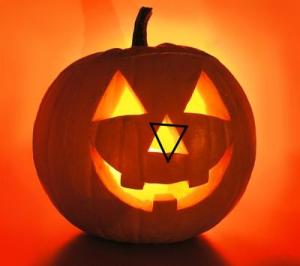 When I was 11 years old, a grumpy Israeli teacher told me that good Jews don’t dress up for Halloween because it’s a Christian holiday when Christians persecuted Jews.
He couldn’t have been more wrong.
First of all, Halloween began as a Pagan holiday, not Christian. The Celtic Pagan year was divided into two halves. The first half, roughly from spring to fall, was for the world of light, and the second half was for the world of darkness. Holidays marked the transitions from each half to the other.
In spring, Beltane celebrated the spiritual beginning of light-filled summer days and the life-giving force of the sun.
By contrast, Samhain (pronounced “sow-an”), the precursor to Halloween, fell on November 1 and represented summer’s end, winter nights, and, in general, darkness. As is typical of gateways and transitions (which are known technically as “liminal” times), Samhain was regarded with suspicion and even reverence. It was seen as a bridge between two opposite worlds: the human world of light and good on one hand, and the netherworld of darkness and evil on the other. Samhain was the time when the inhabitants of the latter might cross over to the former.
The custom of masks and costumes probably comes from the holiday’s general celebratory character. Some people may have dressed up specifically as ghouls to chase away the real evil powers, perhaps hoping that the denizens of the netherworld would try to distribute themselves evenly, and, seeing an abundance in one place, would go elsewhere. Or they may have thought that even the goblins were afraid of other goblins.
The Catholic Church highlighted the theme of the dead on the holiday when it adapted Samhain for its own purposes, merging it into its existing day for saints. All Saints Day, as it was called, was a time for recognizing the power the saints have over the still living. In some traditions, people paid special homage to the newly dead or offered prayers on behalf of the souls stuck in purgatory, hoping to pave a way to heaven rather than hell. Some people carried candles in turnips to represent the souls stuck in purgatory. In America, these would become our jack o’lanterns.
Since Catholic mass was held on the day, All Saints Day was also called All Saints Mass, the Middle English for which is Alholowmesse, and the Modern English for which is Hallowmas. (Christmas similarly gets its name from the mass held for Christ.)
Because the Catholic Church at the time still followed the Jewish tradition of reckoning days from sundown to sundown, Alholowmesse actually began on the evening before November 1, that is, on the evening of October 31, which was called Alholowevening, or more colloquially Alholowe’en. That gave us our Modern English name Halloween.
In addition to offering words of prayer for the dead, some Christians prepared physical food for their departed loves ones. Once food was potentially available, the poor wanted in on the action, and before long, the holiday became, in part, a day for begging (leading to Shakespeare’s image of “a beggar at Hallowmas.”) Some poor people asked for food outright. Others combined two Hallowmas traditions and agreed to offer a prayer for a provider’s dead relatives in return for a little sustenance.
But the Puritans who largely founded America despised both the Pagan and Catholic aspects of Halloween, and in this country Halloween was never regarded as a sectarian celebration. It wasn’t even on most American calendars until the mid-nineteenth century. When it finally did take root, it was a mixture of pranks, dress up, jack o’lanterns, and candy, none of which is un-Jewish in any way. So my grumpy Israel teacher was wrong.
He was equally wrong when he told me that Halloween was created to persecute Jews. There were no Jews living among the Celts when Samhain arose, and the Jews had already been exiled from England by the time the Christians turned Samhain into All Saints Day there.
But he was most severely wrong in his general approach. He failed to distinguish the history of the holiday from the holiday itself. If we abandoned everything that had a disagreeable history, we’d have to give up many of our favorite Jewish rituals, too.
Whatever their non-Jewish roots, American holidays such as Thanksgiving and Halloween are now symbols of pluralism, yearly signposts advertising America’s freedom and tolerance. These holidays are an opportunity for Americans, regardless of background, to come together and share an experience. And they can even be an enormous amount of fun.
Pluralism, tolerance, community, and fun are all Jewish ideals, and I, for one, am looking forward once again to greeting bizarrely dressed children as they come to my door and ask for treats.
I Have a Little List
By Joel M. Hoffman
“These things have no limit,” begins a nearly 2,000-year-old list in the Mishnah, our earliest collection of Jewish law. The list details commandments for which more is always better.
Leaving unharvested crops (“pe’ah“) for the poor, for instance, is the first item there. Leviticus (23:22) asks farmers to leave the corners of their fields unharvested so that the poor can — free of charge and anonymously — gather food. The more crops left for the poor, the more people eat. Feeding some hungry people is good; feeding more is better. That’s why there’s no limit.
But the real point of the list is that good things come in two varieties. For some, the more you have the better. That’s what we all expect. But it turns out that some good things — perhaps even most — are only good in moderation, and even turn detrimental with quantity. They not only stop being good, but they can actually become bad.
Food, for example, falls in this second, non-intuitive category. We think of food as a good thing because it’s yummy and we need it to survive. But while 2,000 calories of food a day is twice as good as 1,000, 4,000 calories is not twice better than that. 16,000 calories a day will kill most people. After a certain point, otherwise life-sustaining food becomes a health hazard.
Modern readers may be surprised to find that prayer is not on the ancient list of things that have no limit, because prayer is like food. You should have enough, the rabbis say, but don’t overdo it. By contrast, g’milut chasadim, being kind, does appear. You can never be too kind or kind too often.
A related list, traditionally juxtaposed with the first, comes from the Talmud. It details things that offer inherent reward in return for doing them: honoring parents, for example, or helping people work out their differences. Honor your parents and you’re more likely to be happy yourself. It’s the right thing to do, but even if it weren’t, it would still be a good idea, because it just so happens that it will make your own life better. Similarly, help two people stop fighting and you don’t have to live amid strife.
The second list even details how these good acts will reward those who do them. Good deed doers earn interest on their investment of beneficence “in this world,” and enjoy the principal “in the world to come.” In other words, you get a little bit of benefit for doing the right thing now, and you get even more benefit later.
We find g’milut chasadim (“being kind”) from the first list on the second list as well. Not only can you never be too kind, but the more kindness you can show, the better things will be for others and for you as well. Karma, some people call it.
Studying Torah is also on both lists. Unlike food, whose benefits turn deleterious after a point, more learning is always better. That’s why it’s on the first list. Its role in the second list is more oblique. We read: studying Torah “is like” all the other things on the list. (A common translation misses the whole point, wrongly claiming that studying Torah “is equal to them all.”) The list doesn’t tell us in what way studying Torah might be “like” honoring parents, helping two people get along, or being kind. Perhaps one has to study Torah to find out? That’s why we spend so much energy on studying Torah, giving children and adults alike a path into Jewish learning. We may not know why, but somehow, the more we study, the more we augment the world’s supply of the other good things, too.
Considerable unhappiness comes from mixing up lists like these. Addiction, for example, is the inability to keep things off of the first, short, list. What about money? Is more always better? Capitalism says yes, but Judaism says no. Wealth isn’t on the list. Maybe, like food, after a certain point money stops improving our lives and even makes them worse.
These complex and important issues are masked in a deceptive facade of simplicity. So as we celebrate a new year together, let’s also find time to reevaluate the lists of our lives.
Shanah Tovah.
On Sale Everywhere!

My Fiction
| Watch the trailer: | Visit the site: |
 |  |
 Joel M. Hoffman, PhD